
Burr Oak Cemetery: When Graves Were Dug Up and Resold
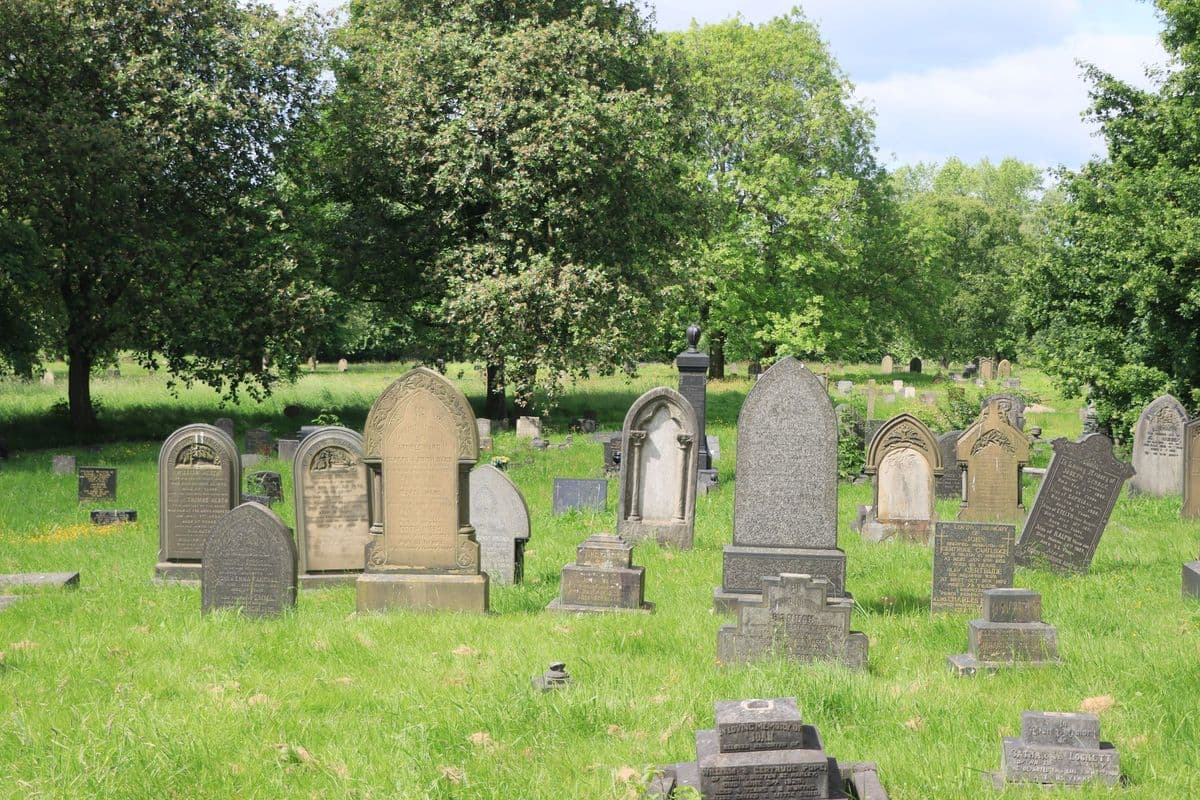
Burr Oak Cemetery is a historic African-American cemetery in Alsip, Illinois, just outside Chicago. Between about 2003 and 2009, its manager took cash from grieving families for burial plots and kept the money. To make room, workers dug up graves that were already occupied. They dumped the remains in a back area of the cemetery, or pushed the old coffin deeper and buried a stranger on top. The Cook County Sheriff's Office uncovered the scheme in July 2009. On 8 July 2011 the manager, Carolyn Towns, pleaded guilty and was sentenced to 12 years in prison (NBC Chicago, 8 July 2011).
That is the short answer to "Burr Oak Cemetery scandal". Three cemetery workers were also charged. Their cases ended in different ways, which we set out below with the court records.
Many people buy a grave and never think about it again. They assume it is theirs forever, and safe. Burr Oak shows what can happen when nobody is checking. This page also explains what you really own when you buy a cemetery plot, and the simple steps that protect it.
This story includes upsetting details about what happened to the dead. We include them only where they help you protect your own family's graves.
A father looks for his daughter's grave
In 1987, a Chicago father buried his two-year-old daughter at Burr Oak, in a section kept for children. For 25 years, that small grave was his link to her.
After the scandal broke, he searched for it. He gathered death certificates and public records. He joined a lawsuit. The cemetery could not locate her grave. Three years later, a settlement cheque arrived. After lawyers' fees, it was for $50.
"That grave site is my only connection to my (deceased) loved ones. Now it's lost. And I get $50," he told the Chicago Tribune (Chicago Tribune via Shaw Local, 21 June 2012). "When you lay somebody down you expect them to stay laid down. You expect them to rest, then you can rest."
Thousands of families went through some version of his search. The sheriff's office received more than 5,000 phone calls and 1,700 emails from people looking for missing relatives (CNN, 9 July 2011).
What Burr Oak Cemetery is
Burr Oak covers more than 100 acres, with about 1,000 to 1,200 gravestones per acre by the industry standard, the appeals court noted (People v. Terrence Nicks, 18 June 2019).
It is the resting place of Emmett Till, the 14-year-old murdered in 1955, and of many prominent African Americans. During the investigation, Till's original glass-faced casket was found in a garage filled with lawn equipment. Groundskeepers told investigators his body had not been disturbed (CNN).
The cemetery also had a section for children, known as "Babyland." The sheriff said he talked to "countless women who could not find their children," CNN reported.
How the scheme worked
Here is the scheme step by step, from the guilty plea and the trial evidence.
1. Take the cash. Families arranging a burial paid the cemetery manager for a plot. "Towns would accept payment from families of the recently deceased, pocket the money and then direct her employees to bury the bodies in graves that were already occupied," NBC Chicago reported. She admitted stealing more than $100,000 from the company that ran the cemetery (CBS Chicago, 8 July 2011).
2. Find an "empty" grave that was not empty. The backhoe would dig until it hit a concrete liner holding a coffin. A worker testified that this happened 10 to 20 times between January and June 2009 alone.
3. Remove the remains, or hide them. One worker testified that the foreman's reply to an occupied grave was to take what was in it "to the back with the rest of the garbage." Remains and broken caskets went by dump truck to a dumping area at the back of the cemetery (People v. Keith Nicks, 29 June 2016).
4. Or "double stack" it. Sometimes workers lifted out the liner and coffin, dug deeper, put the coffin back lower down and covered it. "The grave thus appeared unoccupied for the next burial," the court recorded.
5. Hide the work. Workers testified that they were told to park dump trucks and backhoes around the grave "so as to block the view of passers-by."
6. Remove the headstones. At least 13 families testified that their relatives' headstones had gone missing in 2009. Some found the grass stripped and fresh dirt on long-closed graves.
7. Rely on bad records. Authorities said "shoddy record-keeping and in some cases records that had literally disintegrated" made it impossible to say exactly how many graves were disturbed (CBS Chicago). That is how the scheme ran for years. Nobody could check.
What investigators found
| Finding | Source |
|---|---|
| About 300 graves estimated disturbed, with the true number unknowable | CBS Chicago, 8 July 2011 |
| More than 1,500 bones recovered from two dump sites in August 2009, from at least 29 people by DNA | Illinois Appellate Court, 18 June 2019 |
| A skeleton in a suit and tie inside a burial vault, with no casket | CBS Chicago, 8 July 2011 |
| More bodies found near the surface in March 2011, after the arrests | CBS Chicago, 8 July 2011 |
| More than 2,000 human remains and grave items reburied in a ceremony on 17 May 2016 | Cook County Sheriff's Office, 16 May 2016 |
The foreman, Keith Nicks, gave a statement to prosecutors after his arrest. He said that when he was hired in April 2004 he wanted to improve the cemetery, but later "became involved with a bad situation." According to the statement, he "knew this happened" about 200 times before he became foreman, and about 100 times after. At trial he denied making that statement (People v. Keith Nicks).
Who was charged, and what the courts decided
Four people were charged after the sheriff's office revealed the scheme in July 2009. Here is how each case ended, according to court records and news reports.
| Person | Role | Outcome |
|---|---|---|
| Carolyn Towns | Director of cemetery operations | Pleaded guilty to every count on 8 July 2011, including dismembering a human body, theft from a place of worship, damaging 10 or more gravestones and desecration of human remains. Sentenced to 12 years |
| Keith Nicks | Grounds foreman | Convicted by a jury in 2015. Sentenced to 6 years on 17 April 2015. Conviction upheld on appeal on 29 June 2016 |
| Maurice Dailey | Backhoe operator | Pleaded guilty in 2015 to desecration of human remains, removal of human remains and removal of gravestones |
| Terrence Nicks | Dump truck driver | Convicted by a jury in 2015 and sentenced to 3 years. On 18 June 2019 the appeals court reversed the conviction because the indictment was not specific enough. He had already served his sentence |
The reversal for Terrence Nicks needs a careful word. The appeals court did not find him innocent. It found that the charges, covering almost six years across a 100-acre cemetery, did not say which graves or headstones he was accused of disturbing. Without those details, he could not properly defend himself. The court added that the evidence on the desecration counts was strong and that the state could charge him again. We found no public record of a retrial.
What they said. Carolyn Towns "is very remorseful, not only for the pain she caused her family, but the families of people who have loved ones at Burr Oak," her lawyer said in court (CNN). "She accepted responsibility." At trial, Keith and Terrence Nicks both denied the admissions prosecutors said they had made after their arrests (People v. Keith Nicks; People v. Terrence Nicks). Prosecutors had asked for 15 years; the judge gave six years and three years (NBC Chicago, 17 April 2015).
Cook County State's Attorney Anita Alvarez said the crimes "demonstrated the cruel lengths that people will resort to for financial gain."
What families got
After the scandal, more than 5,000 people joined lawsuits against the cemetery's owner, Perpetua-Burr Oak Holdings. The company went bankrupt. About $2.3 million was set aside to pay its creditors, including those families (Chicago Tribune via Shaw Local).
- Most families took a payment of about $100. After lawyers' fees, some received $50.
- About 370 people who could show serious harm shared about $1.2 million, an average of about $3,300 each.
- Some families gave up their payment so it could go to a fund to maintain the cemetery.
- More than $2 million of insurance money was set aside to clean up the cemetery and build a memorial.
The court-appointed trustee who took over the cemetery said: "Nobody is going to be happy. Who wants to know that their loved one's grave was possibly desecrated? But I can guarantee you that not every grave out there was dug up. Most are still there."
Burials resumed under new management. In May 2016, the sheriff held a ceremony to rebury the recovered remains "with dignity and respect" in the rear section where most had been found (Cook County Sheriff's Office).
What Illinois changed
Before Burr Oak, Illinois cemeteries were overseen under older laws run by the state Comptroller's office. Afterwards, the state moved fast.
The Cemetery Oversight Act passed the legislature on 13 January 2010, was signed on 17 January and took effect on 1 March 2010 (Township Officials of Illinois, April 2010). It moved cemetery oversight to the state's professional regulator, the Department of Financial and Professional Regulation (IDFPR), which now licenses cemetery authorities, managers and customer service staff (IDFPR).
The Act requires cemeteries to:
- keep an overall map of every lot and section, and open it to public inspection;
- keep an index linking each person buried to their exact place;
- enter every burial into a statewide database within 10 business days;
- give a written contract signed by both sides, with prices;
- publish a standard price list;
- accept payment by means other than cash only;
- post signs with the state's consumer hotline and how to complain.
It also set out a Consumer Bill of Rights, including a burial contract that describes the exact location of the grave, and protection from "deceptive or unfair practices."
The sheriff summed up the reason. "We can never let the cemetery industry slip into anonymity again," he said (NBC Chicago).
These rules apply in Illinois. Other states have their own laws, and some are much weaker.
What you really buy when you buy a grave
Most people think they buy a piece of land. Usually, you buy something narrower: a right to be buried in a particular space, often called an interment right or burial right. The cemetery still owns and manages the ground.
That matters in three ways.
1. Upkeep may cost extra. "Perpetual care on a cemetery plot sometimes is included in the purchase price, but it's important to clarify that point before you buy," the FTC says. If it is not included, look for a separate endowment care fee (FTC, Buying a Cemetery Site).
2. An unused plot can, in rare cases, be reclaimed. In Illinois, a cemetery can treat a plot as abandoned only when strict tests are met. For example: no marker, nobody known to be buried there, no transfer in the records, at least 50 years since the right was sold, and no contact from the owner. Even then, the cemetery must publish a newspaper notice and get a court order, and the owner has a year to come forward (Township Officials of Illinois). Reselling an occupied grave has no legal route at all.
3. Not every grave is permanent. Illinois allows "term burials" for a fixed period, though most cemeteries there do not sell them. If you are offered a cheaper plot, ask whether it is a term burial.
Can you sell a cemetery plot?
Often, yes. Many people inherit plots they will never use. But resale needs care, on both sides.
If you are selling: Find the original deed or certificate of interment rights. Contact the cemetery first. Ask whether transfers must go through its office, and whether there is a fee. Get the transfer recorded in the cemetery's own books.
If you are buying a resale plot: Ask the cemetery office, not only the seller, to confirm in writing that:
- the seller is the recorded owner of the right;
- the space is unused;
- the right can be transferred to you, and what that costs;
- the exact location matches the cemetery map.
Then make sure the transfer is recorded in your name. A private sale that the cemetery never records can leave you with a piece of paper and no grave.
Red flags you can check yourself
None of these proves wrongdoing. Each is a reason to ask one more question.
1. Cash only, or "cash is easier." At Burr Oak, cash paid to the manager never reached the business. Illinois now bans cash-only cemetery sales. Pay in a way that leaves a record.
2. No written contract, or no exact location. Your contract should name the section, lot and space. Ask to see it on the map.
3. The office cannot show you a map. In Illinois you have a right to inspect it. Anywhere, a cemetery that cannot show where its graves are has a records problem.
4. Missing headstones or fresh dirt on old graves. Families at Burr Oak noticed exactly this in 2009. If you see it, ask the office, then report it to your state regulator.
5. A "new" plot in a full, old section. Ask how the space became available.
6. Records on paper only, in poor condition. Ask whether your loved one's burial is recorded in a state database, where one exists, or at least in a backed-up register.
How to protect a family grave
These steps take an afternoon, and they last for generations.
- Find the deed. Keep it with your other important papers, and make a copy.
- Get the exact location in writing: section, lot, space number. Take a photo of the grave and the nearest landmarks.
- Ask what perpetual care covers, and whether it is paid.
- If you own unused plots, write them into your planning papers. Say who should use them, or whether they should be sold. Unknown plots are how families lose track of graves.
- Visit, or ask a relative to visit, now and then. Families who visit notice change.
The honest lesson
The families at Burr Oak trusted that a grave meant rest. They should have been able to. The failure belonged to the people who ran the cemetery, and to a system that did not check.
Death is the end of a life. A grave is how a family keeps that life close. Planning for it is not morbid. It is how you make sure the place you choose stays yours, and that your family can always find it.
Our free end-of-life readiness check shows what is still missing from your plans, including where your important papers are. To see what burial and plots usually cost where you live, use our free funeral cost estimator.
The Complete Planning Library includes a funeral and memorial planning sheet with space for your plot details, and a "where to find everything" list for deeds and contracts. It costs $39, once, with a 30-day refund. It cannot police cemeteries. It makes sure your family knows exactly where you want to rest, and has the papers to prove it.
Burr Oak is one of several cases where families trusted the people caring for their dead. In Colorado, a funeral home gave families concrete instead of ashes: read Return to Nature Funeral Home: 189 Bodies and Fake Ashes. For your rights on funeral and cemetery prices, see Funeral Home Price Tricks: What the FTC Funeral Rule Says.
Sources
- NBC Chicago: Mastermind of Burr Oak scheme sentenced to 12 years (8 July 2011)
- CBS Chicago: Former Burr Oak Cemetery director admits to scheme (8 July 2011)
- CNN: Ex-director of Illinois cemetery sentenced in burial scheme (9 July 2011)
- Illinois Appellate Court: People v. Keith Nicks, 2016 IL App (1st) 151296-U (29 June 2016, PDF)
- Illinois Appellate Court: People v. Terrence Nicks, 2019 IL App (1st) 151064-U (18 June 2019, PDF)
- NBC Chicago / Chicago Sun-Times: Brothers sentenced in Burr Oak Cemetery scandal (17 April 2015)
- Chicago Sun-Times: Former Burr Oak Cemetery worker pleads guilty to desecrating bodies (2015)
- Cook County Sheriff's Office: re-interment ceremony for remains recovered at Burr Oak (16 May 2016)
- Chicago Tribune via Shaw Local: Three years after Illinois cemetery scandal, litigation comes to an end (21 June 2012)
- Township Officials of Illinois: Cemetery Oversight Act sets up Consumer Bill of Rights (April 2010, PDF)
- Illinois Department of Financial and Professional Regulation: Cemetery Oversight
- FTC: Buying a Cemetery Site (July 2012)
Common questions
- What happened at Burr Oak Cemetery?
- Between about 2003 and 2009, workers at Burr Oak Cemetery in Alsip, Illinois, dug up graves and resold the plots to grieving families. Remains were dumped in a back area of the cemetery or pushed deeper so a new coffin could sit on top. The cemetery manager took cash from families and kept it. The Cook County Sheriff's Office uncovered the scheme in July 2009.
- How many graves were disturbed at Burr Oak Cemetery?
- Nobody knows exactly. Authorities estimated about 300 graves in 2009, but said poor and disintegrated records made a full count impossible. Investigators recovered more than 1,500 bones from at least 29 people from two dump sites, and the sheriff later reburied more than 2,000 human remains and grave items.
- What happened to Carolyn Towns?
- Carolyn Towns, the former cemetery manager, pleaded guilty on 8 July 2011 to every count against her, including dismembering a human body and theft from a place of worship. She admitted stealing more than $100,000 from the company that ran the cemetery and was sentenced to 12 years in prison.
- Were the Burr Oak workers convicted?
- Foreman Keith Nicks was convicted in 2015 and sentenced to six years; his conviction was upheld in 2016. Backhoe operator Maurice Dailey pleaded guilty in 2015. By May 2016, the sheriff's office said, all four defendants had been convicted and sentenced. Terrence Nicks was convicted in 2015 and served a three-year sentence, but an appeals court reversed his conviction in June 2019 because the indictment was not specific enough.
- Is Emmett Till buried at Burr Oak Cemetery?
- Yes. Emmett Till is buried at Burr Oak. During the 2009 investigation, his original glass-faced casket was found in a garage full of lawn equipment. Groundskeepers told investigators his grave had not been disturbed, CNN reported.
- Can a cemetery resell a grave?
- Only in limited, legal ways. In Illinois, a cemetery can reclaim an unused plot only if it is presumed abandoned, for example after 50 years with no burial, no marker and no contact from the owner, and only after a newspaper notice and a court order. Reselling an occupied grave, as happened at Burr Oak, is a crime.
- Is a cemetery plot yours forever?
- Usually you buy a right to be buried there, called an interment right, rather than the land itself. Most burials are permanent, but some states, including Illinois, allow 'term burials' for a set period. Read your contract and keep your deed. Ask whether perpetual care is included.